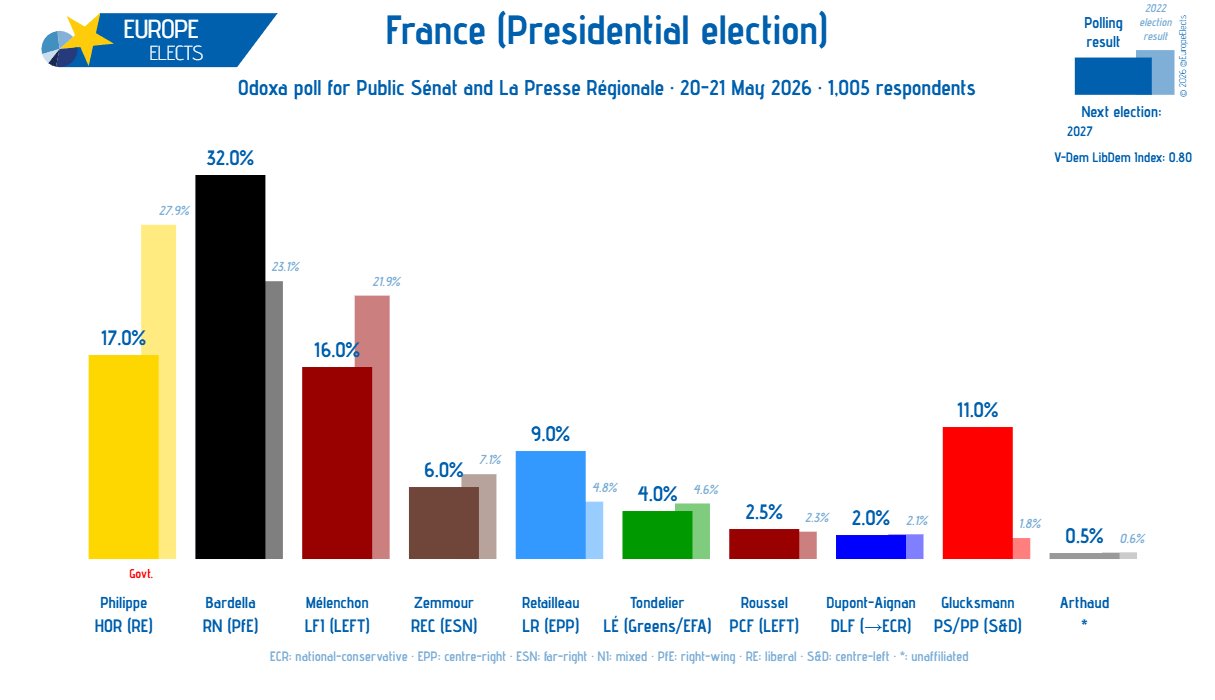
A new French poll puts National Rally leader Jordan Bardella on course to win the 2027 presidential election.
A parallel surge for far-left candidate Jean-Luc Mélenchon is also threatening to reshape the race in ways that could hand the far right its largest electoral victory in the poll's history.
What the poll shows
According to an Odoxa survey published on Tuesday 26 May 2026, Bardella would beat former Prime Minister Édouard Philippe - currently the leading centrist candidate - by 52% to 48% in a second-round runoff. The margin is narrow but consistent with a trajectory that has seen Bardella consolidate his position as frontrunner over recent months.
The more significant finding concerns the first round. Mélenchon, the firebrand leader of France Unbowed, has surged to 16% - up from 12% in last month's equivalent poll - placing him virtually level with Philippe, who has slipped from 21% to 17%. Mélenchon is now the most popular left-wing candidate among left-leaning voters, with 49% support among that group compared to 43% for former President François Hollande and 36% for MEP Raphaël Glucksmann.
"For Édouard Philippe, this poll in May is sounding alarm bells, with a double hit that shows him dropping behind Bardella in the second round and within range of Mélenchon," wrote Odoxa head Gaël Sliman.
Why this matters for French Muslims
A Bardella presidency would represent the most consequential shift in French government policy toward Muslim communities in decades. Bardella has made immigration and what he describes as Islamism central to his political platform, and has consistently called for more restrictive measures on Muslim religious expression in public life.
The National Rally's programme includes proposals to restrict the wearing of the hijab in all public spaces, further expand the application of laïcité to associative life, and tighten state oversight of Muslim organisations and mosques. These proposals go significantly further than the already extensive legislative restrictions introduced under Macron since 2021.
The party's position on Islam in France is not peripheral to its programme - it is central. The RN has built its electoral coalition in significant part on hostility to what it frames as Islamisation, and an RN presidency would give that agenda executive power for the first time.
The Mélenchon factor
The scenario France's centre dreads is a Bardella-Mélenchon runoff. A previous Odoxa poll, published in November 2025, projected Bardella would beat Mélenchon by 74% to 26% - a landslide. Mélenchon qualifying for the second round instead of Philippe would, paradoxically, make a Bardella victory considerably more likely and considerably more decisive.
Mélenchon's relationship with Muslim communities in France is complex. France Unbowed has been among the most vocal critics of Islamophobia legislation and has opposed the anti-separatism law. But his divisive personality and his party's associations with hard-left economic positions make him a polarising figure whose path to the Élysée is widely seen as structurally blocked against a far-right opponent.
Background
Jordan Bardella, 29, became president of the National Rally in 2022, succeeding Marine Le Pen who stepped back to lead the party's parliamentary group. He is widely regarded as Le Pen's political heir and has been groomed for the presidency as a younger, more telegenic face for the party.
Édouard Philippe served as Prime Minister under Emmanuel Macron from 2017 to 2020. He has positioned himself as the candidate of the centre-right and has been seen as the most credible non-far-right candidate capable of defeating Bardella in a runoff.
The 2027 presidential election is scheduled for April-May 2027. Macron is constitutionally barred from standing for a third term.
Q&A
Who is Jordan Bardella and what does he stand for on Islam? Jordan Bardella is the 29-year-old president of the Rassemblement National and Marine Le Pen's chosen successor as the party's public face. He has made immigration restriction and opposition to what he calls Islamism and Islamisation central to his platform, calling for bans on the hijab in public spaces and tighter state control of Muslim organisations. An RN presidency under Bardella would likely accelerate and intensify the legislative restrictions on Muslim public life already introduced since 2020.
What is the National Rally's position on Muslim communities in France? The RN proposes to extend existing bans on religious symbols to all public spaces, restrict foreign funding of mosques, tighten oversight of Islamic associations, and pursue what the party describes as the defence of French secular values against political Islam. Critics, including human rights organisations and the CCIE, describe these proposals as institutionalised Islamophobia that would significantly curtail the religious freedoms of France's six million Muslims.
What would a Bardella-Mélenchon runoff mean? If Mélenchon qualifies for the second round instead of Philippe, polling consistently projects a landslide Bardella victory - the November 2025 Odoxa poll put it at 74% to 26%. For Muslim communities, a Bardella victory in any scenario represents a significant risk, but a landslide victory would give the RN a stronger mandate and potentially a parliamentary majority capable of passing its most ambitious legislative proposals.
When is the next French presidential election? The election is scheduled for spring 2027. Emmanuel Macron is constitutionally barred from standing for a third consecutive term, making 2027 an open race for the first time since 2012.
Sources: Politico / Odoxa / France Unbowed / National Rally